
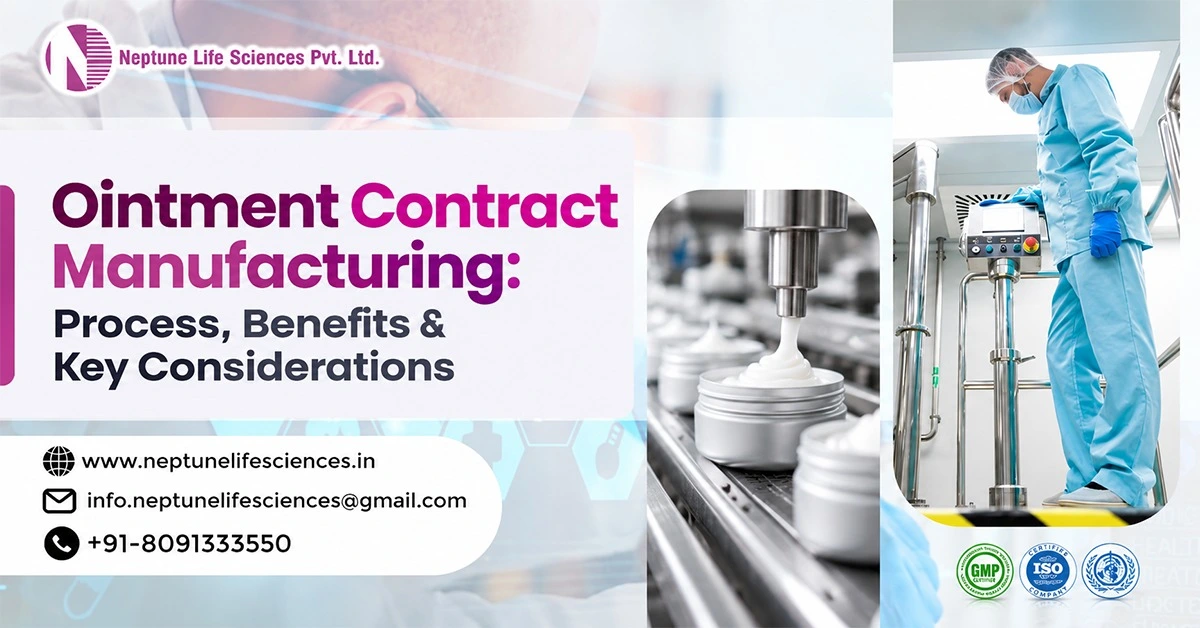
Pharmaceutical companies that want to market their own topical healthcare product but don’t want to set up their own manufacturing unit can turn to ointment contract manufacturing. Ointment Contract Manufacturing lets companies create and market a wide range of products, such as dermatological ointments, antibacterial and antifungal products, and pain relievers, with an experienced and supportive pharmaceutical manufacturer.
It is crucial to understand the manufacturing process, the important benefits, and the main points for selecting a Pharmaceutical Contract Ointment Manufacturing partner before entering into a contract manufacturing arrangement.
What is Ointment Contract Manufacturing?
A structured manufacturing process ensures that products produced are of the required specifications, as well as consistency between products. The general process of formulation is as follows and depends on the product and product type.
What is the Ointment Contract Manufacturing Process?
1. To determine what kind of ointment to make, how to use it, and what kind of buyer segment it’s aiming at.
Depending on the product strategy and relevant authorization, the topically applied product can be dermatological, antifungal, antibacterial, or even analgesic.
The manufacturer analyzes the suggested formula, compatibility of ingredients, stability criteria and feasibility of production before settling the final formula.
2. Raw Material Procurement
Active pharmaceutical ingredients and excipients suitable for use are obtained from approved suppliers. The raw materials should be identified and checked in line to the appropriate specifications before using them.
Consistency between production batches is maintained by using the right material and by ensuring the material supplier’s qualification.
3. Manufacturing and Processing
The typical steps in developing ointment generally include weighing of ingredients, formulation of the base composition, addition of the active ingredient(s), and mixing the formulation under controlled conditions. Some heat treatment, cooling, homogenisation, or other processing methods may be required depending on the product.
4. Quality Control and Testing
Quality test is an indispensable process of manufacturing of ointment. Tests could encompass appearance, consistency, pH (as applicable), assay of active ingredients, microbial quality, and other product-specific parameters, depending on the formulation and applicable standards.
5. Packaging and Labelling
Ointments can be dispensed in appropriate tubes, jars, or other containers approved by the pharmacy. Packaging selection relates to product compatibility, protection requirements, ease of application, and preference of the target market.
What Are The Benefits of Ointment Contract Manufacturing?
1. Reduce infrastructure and operation expenses
Establishing a control room or a pharmaceutical manufacturing unit means investing in the layout, machinery, installation of utilities, hiring competent workers, and implementing a quality-control system. The advantage of contract manufacturing for such businesses can be lowering the costs of these investments, concentrating on branding and distribution, and marketing within a business.
2. Manufacturing expertise is accessible at one or multiple locations
A professional manufacturing partner can bring trusted production technologies and quality management systems to help alleviate batch-to-batch variability and make your formulation process easier.
3. Greater Business Flexibility
Business organizations can look into different ointment formulations and can also develop the product line as market requirements change using outsourcing services. The number of production and manufacturing arrangements can be scheduled per the requirement of the business and the contract.
4. Focus on branding and market expansion.
The business will have more time to spend on customer relationships, developing the distributor network, promotional activities, and market development once manufacturing is offshored. This is mainly useful for the start-up and pharma franchise companies operating in the most competitive areas of therapies.
Visit Us At: Plot no. 100 B, EPIP, Phase-II, Thana, Baddi, Himachal Pradesh 173205
Key Considerations While Choosing a Pharmaceutical Contract Ointment Manufacturer
Choosing a manufacturing partner is not without its challenges in assessing technical capabilities and commercial terms. Before businesses sign an agreement, they should have an idea about the following.
Verify that the product and dosage form have been approved for sale by the manufacturer with all appropriate licensing. Review (and do not just “tell me”) the manufacturer’s GMP compliance documentation and inspection reports.
Product line and experience: Find out if the company has produced the specific type(s) of ointment you need, how they make those types of ointment, and what kind of packaging is needed for each.
Quality Assurance: Questions to ask: Raw Material Testing, In-Process Control Testing, Finished Product Testing, Batch Documentation, Stability Testing, Complaint Handling, Product Recall.
Minimum order quantity and pricing: minimum order quantity (moq) is offered; cost for developing products; cost of packaging; payment terms; and pricing adjustment options.
The capacity/delivery date can be checked by verifying whether or not a manufacturing firm has enough production capacity to produce the quantity of items that were ordered, and can provide a realistic estimated completion date.
Why Choose Neptune Lifesciences?
Pharmaceutical Manufacturing: We at Neptune Lifesciences are equipped with updated infrastructure and quality systems, which enable us to deliver Pharmaceutical Manufacturing services of the highest quality.
- Our Strengths
- WHO-GMP Manufacturing Standards
- Advanced Production Facilities
- Experienced Quality Team
- Third Party Manufacturing Support
- Wide Product Portfolio
- PCD Pharma Franchise Opportunities
- Pan-India Business Network
Conclusion
Ointment Contract Manufacturing for the pharmaceutical industry, ointment contract manufacturing can be an ideal way to quickly expand their portfolio of topical products without having to put up their own manufacturing facility. There are several steps in the process that require planning and coordination to bring the product from the formulation to the final product.
Frequently Asked Questions
Q1. What exactly is meant by ‘on-hire’ in such a contract manufacturing of ointments?
Ans. Is a contractual agreement that stipulates that the pharmaceutical company is responsible to sell the prepared ointment to the customers. As per the rules and charged terms on the contract while having a legally approved license for the production of ointment from a third party.
Q2. What documents would you look at before choosing an ointment manufacturer?
Ans. Companies need to confirm that they have the necessary manufacturing licenses and the relevant GMP paperwork, product authorization, product quality records, and contractual agreements. The requirements will differ based on the product and jurisdiction.
