
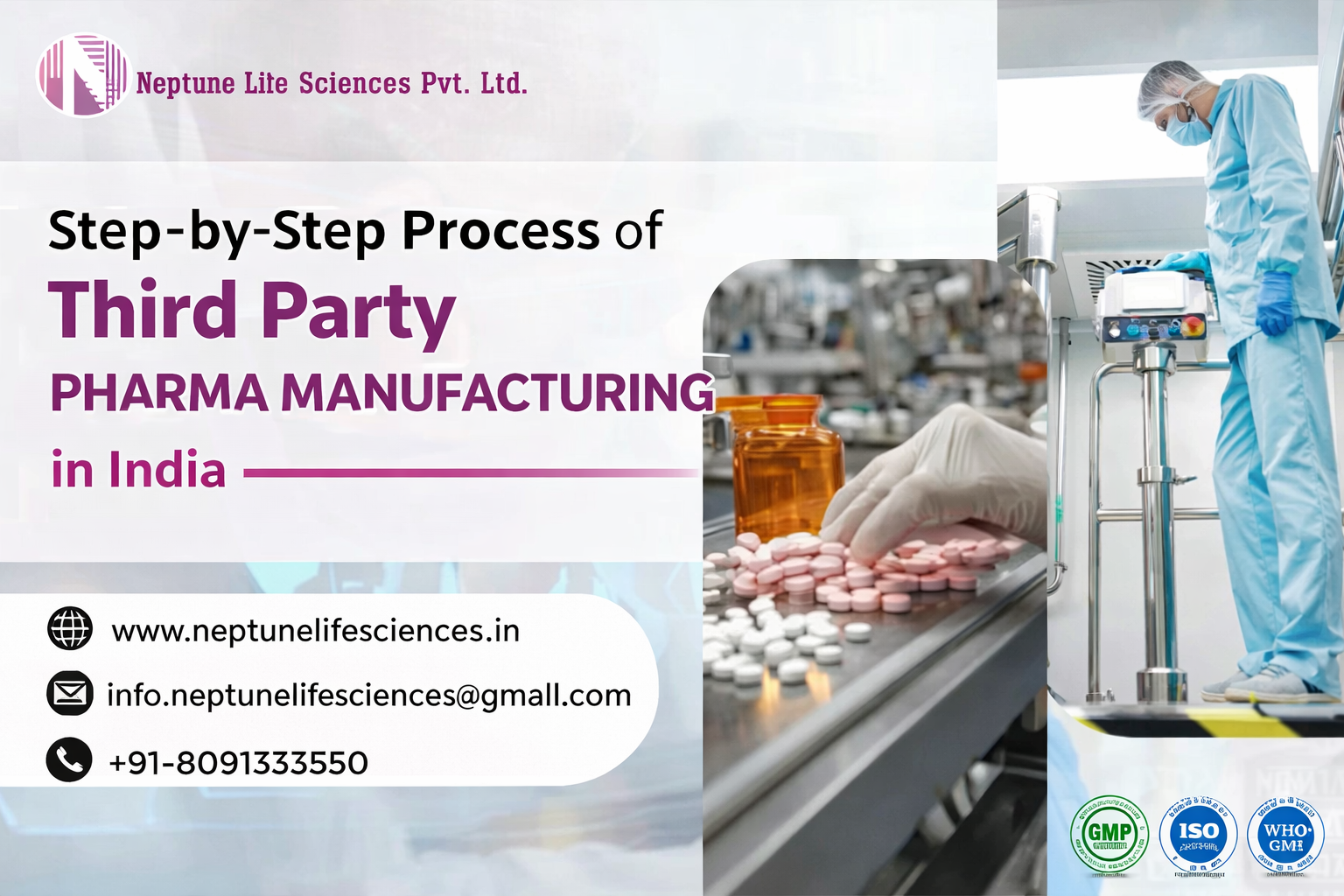
Currently, there is a tremendous transition in the Indian pharma industry towards advanced certification and innovations. Due to the third party pharma manufacturing process, entrepreneurs can meet this increasing demand without establishing their production facilities. The sector’s yearly turnover is ₹4.72 lakh crore, according to the Economic Survey of 2026. The industry exports life-saving drugs to over 191 countries in the world. Such a significant achievement is due to the 7% CAGR in the exports of the sector over the past decade.
Therefore, the entrepreneurs prefer outsourcing due to the estimated market value of the pharma market, which is $60.32 billion for this year. Strategic manufacturing collaboration makes it possible to scale up and ensure the best standards of production for your brand. With the help of a manufacturing company, entrepreneurs can fully concentrate on advertising and treatment.
Basic Principles of Working of Third Party Pharma Manufacturing Service
The brand owner orders a specialized manufacturing unit to create pharmaceutical preparations for their brand. A dedicated manufacturer will take care of all stages of the pharma contract manufacturing process, starting with the procurement of raw materials and ending with the final packaging under the brand name you want.
- You avoid spending millions of dollars on equipment and leasing land for a factory.
- A team of specialists takes care of complex chemical synthesis.
- You receive access to laboratory research and WHO-GMP facilities.
- Your brands can release multiple types of medication targeting various markets.
- Flexible scalability will be useful when producing large or small batch sizes.
To put it briefly, you come up with a product idea, and the producer realizes it under certain conditions. This is essentially how third party pharma manufacturing works to help you get into the market with a minimal investment of only ₹2 to ₹5 lakhs. That is why this method is the best choice for the development of both new startups and existing pharmaceutical companies.
Step-by-Step Guide from the Idea to the Manufacture of Products
Selection and Finalization of Products
The first step in your third party pharma manufacturing process is the selection of appropriate molecules based on current medical demand and prescriptions of doctors.
Cost Quotation and Its Approval
As soon as you choose the products, the manufacturer creates a detailed quotation indicating the cost of raw materials, packaging, and the service. Following this step by step pharma manufacturing guide ensures that all financial aspects are transparent before production begins.
Art and Design Approval
This step in the pharma contract manufacturing process implies designing your product’s logo and the carton design. Your manufacturer will check whether it complies with labeling regulations.
Procurement of Raw Materials
After receiving the design approval, the manufacturer will procure only authorized and certified active pharmaceutical ingredients (APIs). These third party pharmaceutical manufacturing steps are vital to ensuring the chemical integrity of your brand’s medicine.
Third Party Pharmaceutical Manufacturing Process of Actual Production and Packaging
Finally, your product passes through the process of mixing and compression. Then, the tablets or syrups will be packaged into sterile blisters or bottles. This physical creation is the core of the third party pharma manufacturing process.
Important Requirements and Documentation Before Outsourcing
- Valid Wholesale Drug License (WDL)
- Goods and Services Tax (GST) Number
- Trademark Registration or Non-Objection Certificate (NOC)
- Company Profile (with Director identification)
- Signed Manufacturing Agreement/Contract
- Approved List of Products (Technical Specifications)
- Certified Non-Resemblance Certificate
- Certificate of Analysis (CoA)
- Approved Packing and Labeling Design
- Official Purchase Order (PO)
Advantages of Certificates PCD Pharma Franchise for Distributors
There are many reasons why the collaboration with certified manufacturers is the best option in the contemporary market. First, certified manufacturers guarantee access to high-quality medicines, making it easier to secure contracts for hospital supplies. This level of quality is a direct result of following a rigorous step by step pharma manufacturing guide.
- Guaranteed supply of high-quality medicines compliant with all local standards.
- Wide range of products (neurological, gynecological, pediatric range).
- Monopoly rights prevent other sellers from entering your territory.
- Minimal expenses for management of the manufacturing workforce.
- Promotion tools in the form of visual aids and samples.
- Profit margins range between 20% and 50% from retail prices.
- Short delivery time – 35 days until the release of the first batch.
Furthermore, all subsequent orders will be even faster because their execution takes only 20 days. Understanding how third party pharma manufacturing works helps you ensure sufficient stock volumes and become a preferred vendor for your customers.
How the Process of Checks and Delivery Is Managed
Quality Control Throughout the Third Party Pharma Manufacturing Process
The production process requires strict supervision to find even minor mistakes. For instance, the specialists can conduct weight variance and hardness tests of tablets during compression as part of the third party pharma manufacturing process.
Laboratory Test Report
All batches go through chemical analysis before their shipment to the customer. These third party pharmaceutical manufacturing steps involve HPLC machines, checking the chemical composition of the product.
Quarantine and Batch Release
The medicines are stored in a specially designated area before receiving all necessary results. Once the release form is signed by the head of the Quality Assurance Department, the goods can be transported.
Logistics for Secure Delivery
A third party manufacturing company uses qualified carriers who guarantee safe delivery of your medicines using temperature-controlled vehicles.
Conclusion
The third party pharma manufacturing process is the key element of success in the pharmaceutical industry of 2026. In combination with outsourcing, it opens opportunities for entrepreneurs who want to improve the health of the population. Neptune Lifesciences provides excellent conditions for this purpose, offering the best technologies and facilities.
FAQ About Outsourcing Pharma Production
What is the initial investment for manufacturing?
To get started with your brand production, you will need only ₹2 to ₹5 lakhs as an initial investment. You will pay for all your medicines, documents, and design.
How much time will it take to deliver the first batch?
The delivery of the first batch will take up to 35 days as it involves obtaining artwork approval and preparing all necessary documents. However, further production is significantly faster—20 days.
Does the service involve any taxes?
The government collects taxes on pharmaceutical manufacturing services depending on the type of products. You have to pay GST equal to 12% or 18%.
DWhat is the minimum batch size?
Manufacturing units usually require a minimum batch size. For tablets, the size is around 30,000 pieces per batch. Syrups come in bottles that range in size from 500 to 1,000.
Who is responsible for product registration?
In the third party pharma manufacturing process, the brand owner should register the brand. However, the manufacturer will provide you with all required documents, such as the COA and the manufacturing license.
Can herbal products be manufactured along with allopathic drugs?
Many pharmaceutical companies have dedicated sections for the production of allopathic and herbal medicines. You have to choose a manufacturer possessing both AYUSH and DCGI licenses.
How do manufacturers ensure stability?
Manufacturing companies conduct special experiments under different temperature and humidity conditions to extend the shelf life of their products. High-quality foils guarantee safety during transportation.
Is there a need for a pharmacist?
You have to obtain a competent person who will be responsible for obtaining WDL. It should be a pharmacist or a vendor with rich experience in the pharmaceutical market.
What happens in the case of a quality test failure?
If a batch does not meet requirements, it will be destroyed and never shipped. Moreover, it requires investigation and elimination of problems related to poor quality control.
Why are many manufacturers located in Baddi?
The city of Baddi is known as one of the best hubs for the pharmaceutical industry due to tax exemptions and perfect infrastructure.
